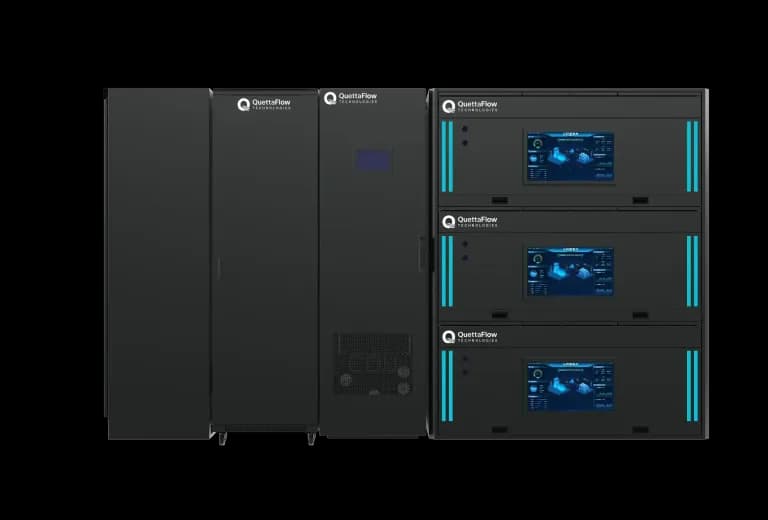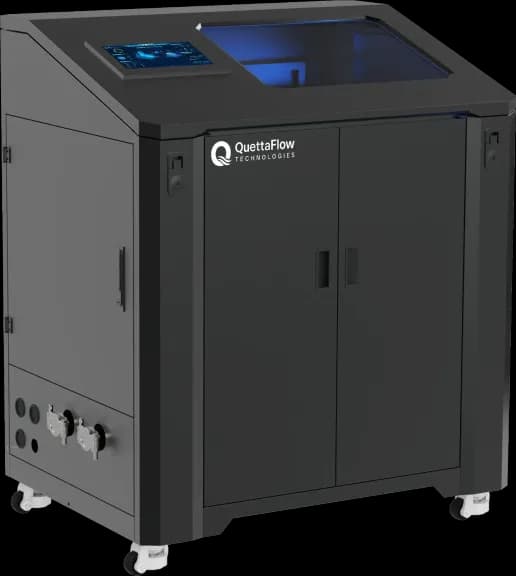
QuettaFlow VasEdge
VasEdge
16U / 12kW / under 55dB
Power12 kW
Solution Blueprints
For sites with the power available and nowhere for the heat to go. Immersion turns a thermal problem into a plumbing problem, which is the solvable one.
Above roughly 40kW in a rack, air stops being a serious option, and the standard answer is direct liquid cooling into a facility water loop. This blueprint is for the case where there is no facility water loop and no realistic way to add one.
That is a site constraint rather than a hardware one, and it is the common case away from a purpose-built hall: a plant room, a retail back office, a converted floor in a building that was never a datacentre. Power is available, the thermal path is not, and no amount of rack engineering creates one. A VasEdge cabinet is the answer at the small end: 16U at 12kW running under 55dB with no raised floor, on 400V with an external dry cooler, and QuettaFlow states four hours from delivery to live. Under 55dB is what lets it sit in a room people work in.
At the other end, a VasRack cabinet is rated 80 to 126kW at a pPUE below 1.1, which is roughly three to five times what a well-built air-cooled rack manages. It operates to 45C, five degrees wider than the VasEdge, and that specification matters more than it looks in this region: a cabinet that tolerates a hot plant room does not need the plant room conditioned first.
What immersion asks in return is a different operating model, and that should be decided before the order rather than discovered after it. Servers are serviced out of fluid and have to drain. Component compatibility is confirmed rather than assumed, because not every drive, thermal interface material or label survives immersion, and vendor warranty terms need checking before the first node goes in. Weight is the other number to check early: a loaded VasEdge is 360kg in a footprint under a square metre, which is a point load an office floor may not be rated for.
Heat leaves through a heat exchanger rather than into the room, and under 55dB at the small end means the room can be one people work in.
360kg loaded in under a square metre, on 400V with an external dry cooler that needs siting. Survey items, not delivery-day surprises.
Drives, thermal interface materials and vendor warranty terms confirmed before the first node goes in, not after.
Tell us the workload and the power envelope you have to work within. We will come back with a configuration, a lead time and a written quote.